Enhancing the Integrity of Algeria's Social Security System: Addressing Fraudulent Activities through Blockchain Technology
A permissioned blockchain earns its place here because CNAS, providers and pharmacies must endorse each other's transactions.
- Author
- Mohamed Lamine Gherbi
- Institution
- University of Mohamed Khider, Biskra, Computer Science Department
- Degree
- Master's in Computer Science, Software Engineering and Distributed Systems (GLSD)
- Session
- 2024-2025
- Supervisors
- R. Bettira, S. Lanani, L. Kahloul
01 / What it is
What it is
The thesis asks whether a permissioned blockchain can make Algeria's social security transactions harder to falsify.
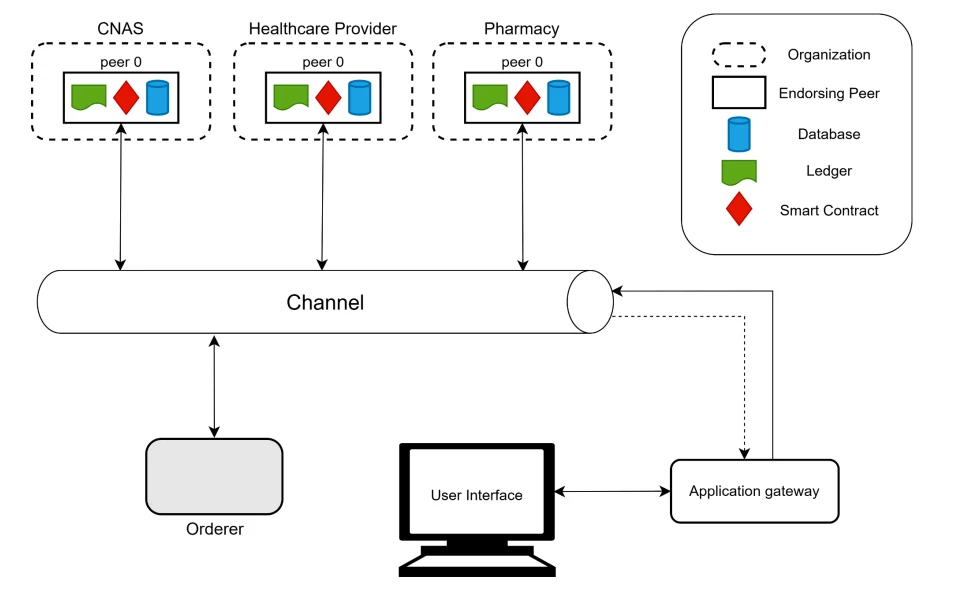
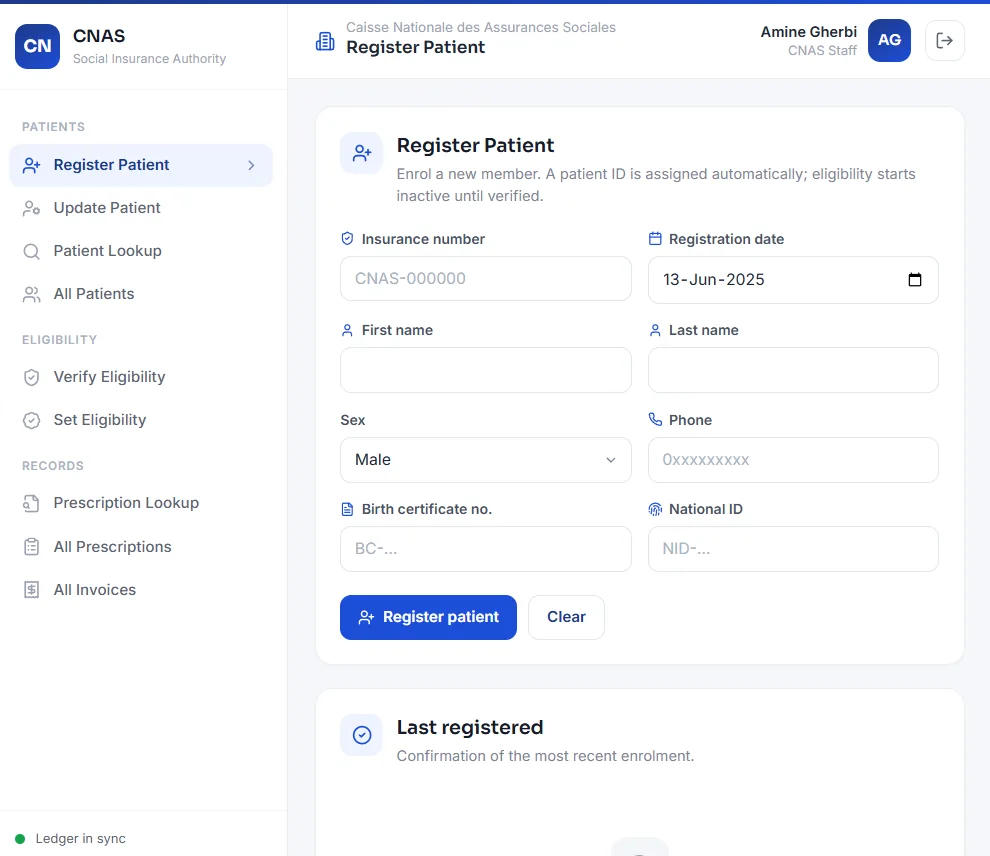
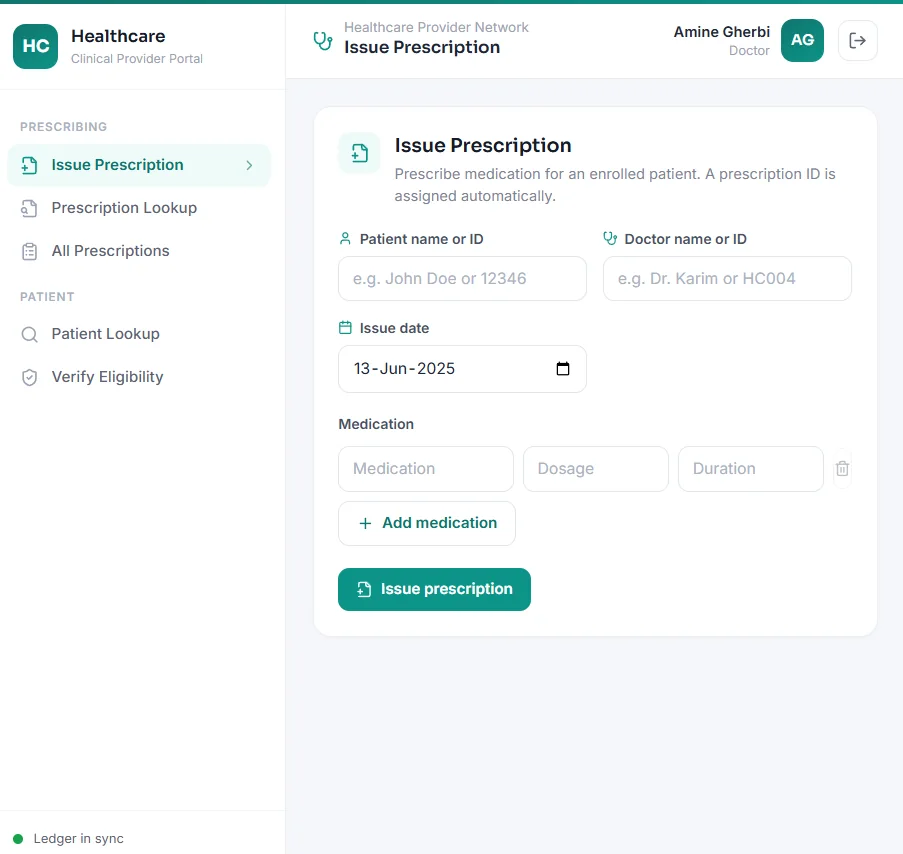
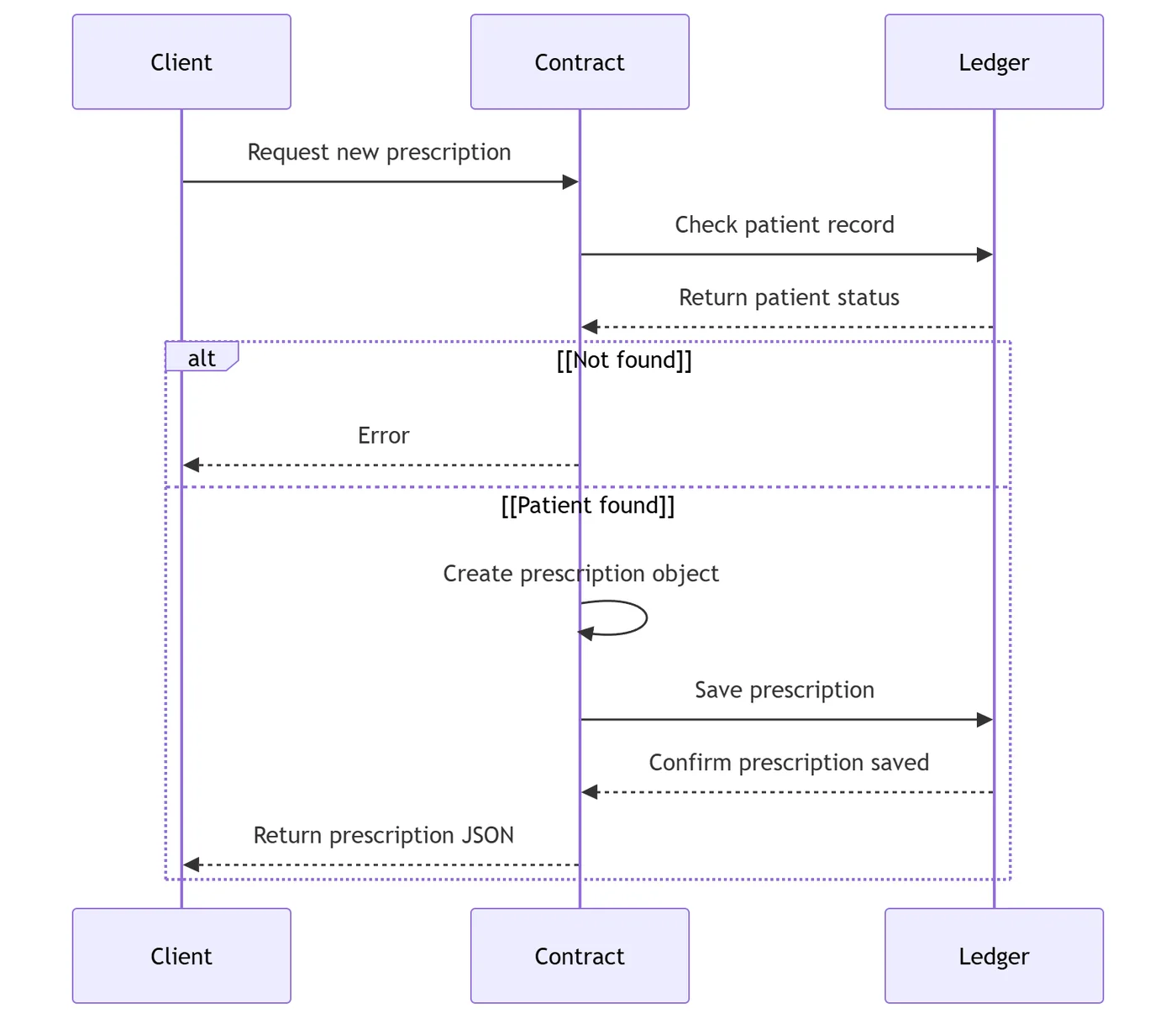
It connects CNAS, healthcare providers and pharmacies to one Hyperledger Fabric channel and moves patient registration, eligibility, prescriptions and invoice settlement into chaincode. A Next.js front end gives each organisation its own section.
The prototype is a local Fabric v2.5 network: three organisation peers, one orderer, one channel and one Node.js chaincode.
02 / The hard part
The hard part
The fraud problem is not a missing database. CNAS, providers and pharmacies keep separate records and can act on them without the others seeing the change.
A patient's eligibility can be changed without a coverage review; a prescription can be issued without CNAS; an invoice can be settled without a matching prescription.
The hard part is making each of those actions require the right parties before it reaches the ledger, without giving one organisation unilateral write authority.
03 / The design
The design
Each organisation runs a peer on mychannel: CNASMSP, HealthcareMSP and PharmacyMSP, with one Raft orderer and TLS. The chaincode is a single Node.js contract, basic.
Endorsement is set per transaction category: patient management needs AND('CNAS.peer'); prescription issuance needs AND('Healthcare.peer','CNAS.peer'); invoice settlement needs AND('Pharmacy.peer','CNAS.peer').
The front end is Next.js with Tailwind CSS, split into CNAS, healthcare and pharmacy sections.
Three organisations
- CNAS Registers patients and changes eligibility status.
- Healthcare providers Issue prescriptions for existing patients.
- Pharmacies Settle invoices against a patient and a prescription.
Nine chaincode functions
-
registerPatientCreates a patient record on the ledger. -
updatePatientUpdates specified fields on an existing patient record. -
verifyEligibilityReturns the patient's current eligibility status. -
updateEligibilityChanges a patient's eligibility status and persists the new value. -
issuePrescriptionCreates a prescription for an existing patient. -
settleInvoiceValidates patient and prescription, then builds and saves an invoice. -
getPatientReads one patient record. -
getPrescriptionRuns a range query over prescriptions. -
getAllInvoicesRuns a range query over invoices.
04 / What it proves
What it proves
The Caliper run exercised three functions, registerPatient, issuePrescription and settleInvoice, at send rates from 100 to 1000 TPS (page 62). It reports 100% success with zero failures. The report records throughput tracking the offered load to about 400 TPS, then plateauing at roughly 80-100 TPS.
Average latency started at 4-8 s, maximum latency reached 10-14 s at the peak, and minimum latency stayed at 1-4 s (page 62). Page 66 records a second summary: 400-500 TPS, 24,000-30,000 transactions per minute, 4-10 s average latency and a fastest path under 4 s.
Both summaries come from the same Caliper run and are kept here as recorded. The run executed the three workflows without a transaction failure under the recorded load.