Claim
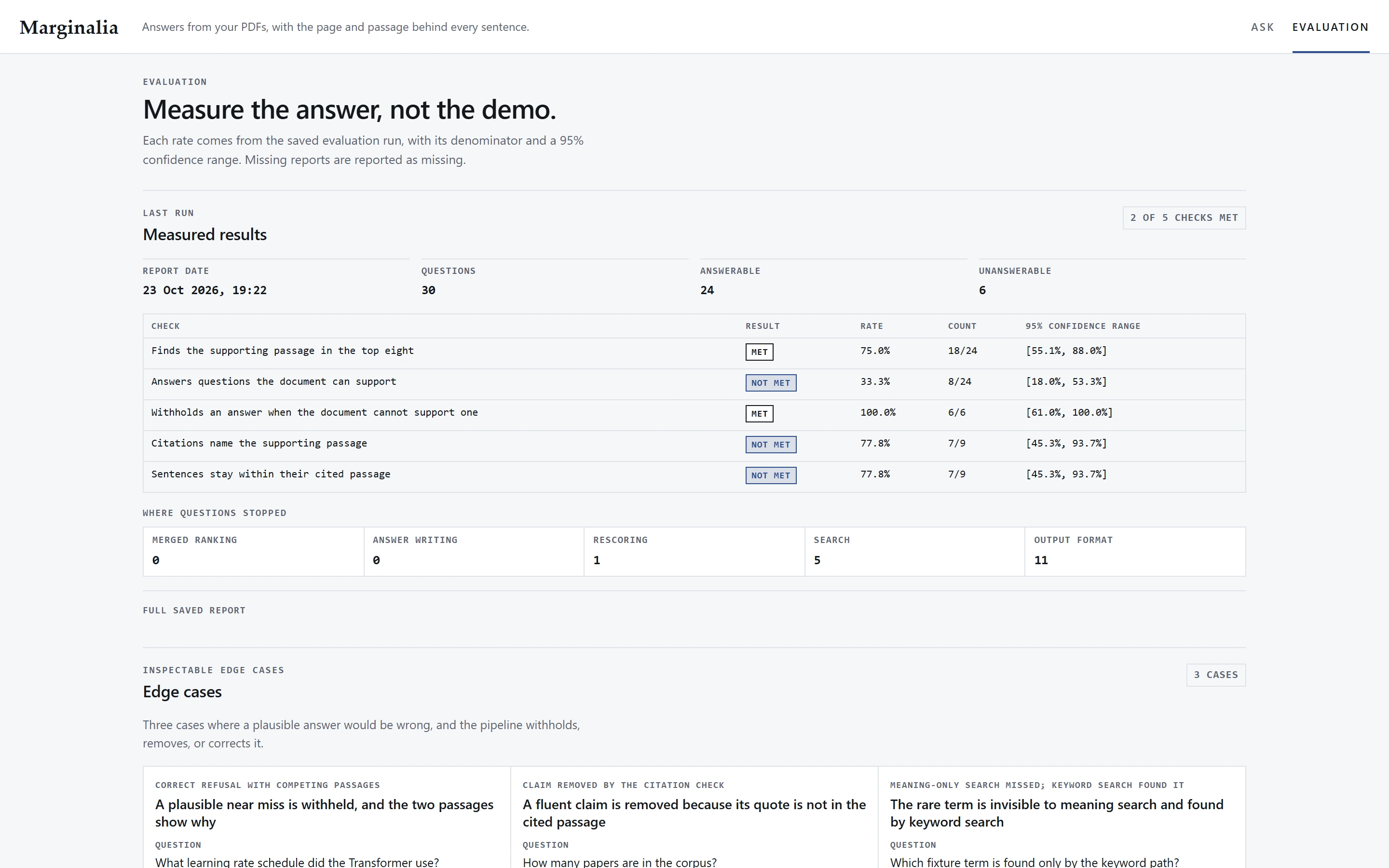
On the recorded 30-question eval, retrieval recall@8 is 18/24 (75.0%), the answer rate is 8/24, refusal of unanswerable questions is 6/6, and citation precision and faithfulness are 7/9 each.
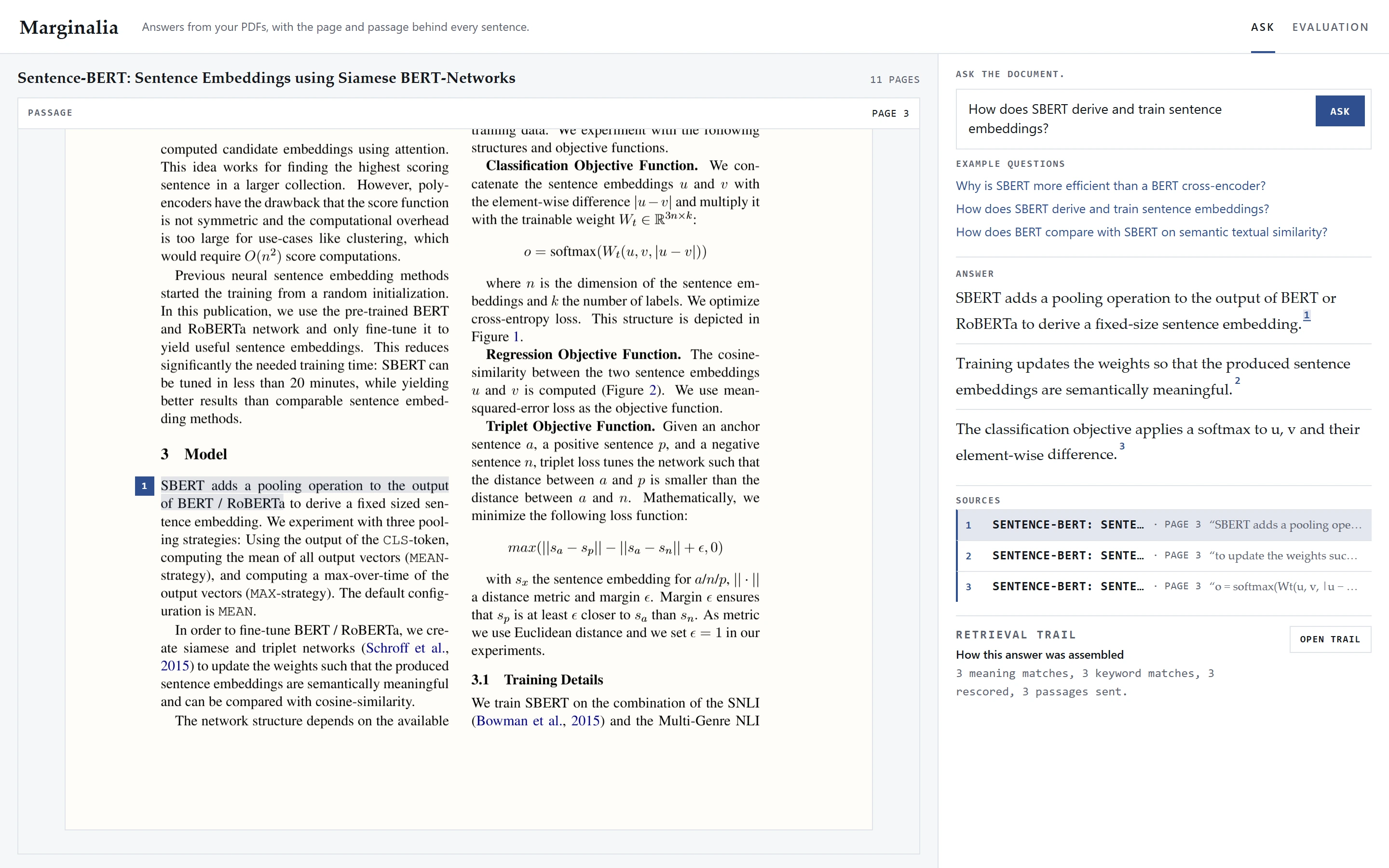
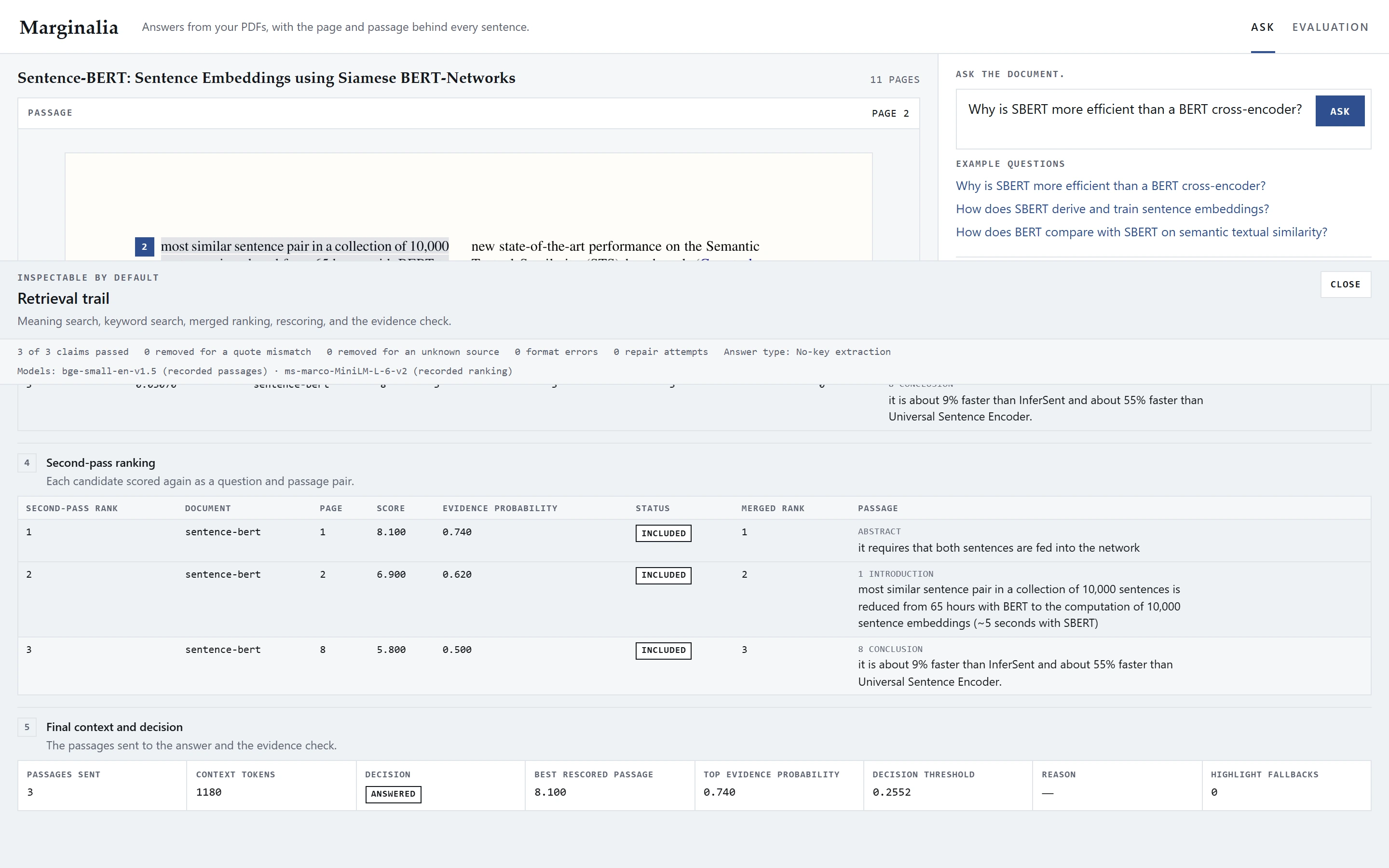
Ask a question about a PDF corpus and get claims whose quotes are verbatim, highlighted on the page, with an inspectable retrieval trace and a calibrated refusal.
01 / What it is
What it is
A Python 3.12 FastAPI service with PostgreSQL 16 and pgvector. Ingest refuses a PDF whose SHA-256 differs from corpus.lock.json; retrieval fuses embeddings and lexical search, then reranks; the answer path keeps a claim when its quote appears in the cited chunk and drops it otherwise.
02 / The hard part
The hard part
A retrieval answer is easy to make plausible and hard to check. A claim can cite a passage outside the retrieved set, quote text outside the cited chunk, or survive a question the corpus holds no evidence for. The refusal path is what makes an answer checkable.
03 / The decision
The decision
An uncited claim is dropped, not repaired
Decision Validate each claim against its citations, require a verbatim quote from the cited chunk, and drop the claim on either failure.
Rejected alternative Generate first, then attach the nearest passage; a citation added afterwards can point at text outside the claim.
Cost The validator drops a reply whose quote is not a verbatim substring, so the answer rate is 8/24.
Evidence The citation tests cover the rejection path; the eval records answer rate, citation precision and faithfulness for every run.
04 / The failure it refuses
The failure it refuses
A fluent answer cites a passage outside the retrieved set, or quotes text outside the chunk it names.
Mechanism Every claim is validated against its citations: the cited passage must be in the retrieved context, and the quote must be a verbatim substring of that chunk. A claim that misses either check is dropped before the answer is returned; the refusal threshold is read from eval/calibration.json at boot.
05 / Measured
Measured
The recorded eval measured recall@8 at 18/24 (75.0%, [55.1%, 88.0%]), answer rate at 8/24 (33.3%, [18.0%, 53.3%]) and refusal at 6/6 (100.0%, [61.0%, 100.0%]). Citation precision and faithfulness are 7/9 each. The run took 778.6 s with 26 model requests, 0 retries and 0 rate limits.
| Metric | Value | Method | Artifact |
|---|---|---|---|
| retrieval recall@8, production (hybrid + RRF + rerank) | 18/24 (75.0%), Wilson 95% [55.1%, 88.0%] | bash scripts/live.sh eval; generator openai-compatible:openai-fast, fastembed bge-small-en-v1.5 + ms-marco-MiniLM-L-6-v2; Windows 11 Pro 10.0.26200, ONNX CPU | eval-report.json |
| answer rate, production, free endpoint | 8/24 (33.3%), Wilson 95% [18.0%, 53.3%] | bash scripts/live.sh eval; generator openai-compatible:openai-fast, fastembed bge-small-en-v1.5 + ms-marco-MiniLM-L-6-v2; Windows 11 Pro 10.0.26200, ONNX CPU | eval-report.json |
| unanswerable refusal, production | 6/6 (100.0%), Wilson 95% [61.0%, 100.0%] | bash scripts/live.sh eval; generator openai-compatible:openai-fast, fastembed bge-small-en-v1.5 + ms-marco-MiniLM-L-6-v2; Windows 11 Pro 10.0.26200, ONNX CPU | eval-report.json |
| citation precision and faithfulness, rule-based | 7/9 (77.8%), Wilson 95% [45.3%, 93.7%] each | bash scripts/live.sh eval; generator openai-compatible:openai-fast, fastembed bge-small-en-v1.5 + ms-marco-MiniLM-L-6-v2; Windows 11 Pro 10.0.26200, ONNX CPU | eval-report.json |
| production eval run cost | 778.6 s; 30 questions; 26 model requests; 0 retries; 0 rate limits | bash scripts/live.sh eval; provenance.run in eval-report.json | docs/ENV.md |
| forced-generation diagnostic (separate diagnostic run) | 8/24 (33.3%), Wilson 95% [18.0%, 53.3%] | bash scripts/live.sh eval --force-generation; openai-compatible:openai-fast | eval-report-forced.json |
Invariants and their tests
- Ingest refuses a chunk longer than 448 model tokens rather than storing a truncated vector.
tests/test_chunking.py - A claim without an in-context citation, or whose quote is not a normalised substring of the cited chunk, is dropped.
tests/test_citations.py - Ingest refuses a PDF whose SHA-256 differs from corpus.lock.json.
tests/test_lock.py - The refusal threshold comes from eval/calibration.json at boot and is never hand-tuned.
tests/test_refusal.py - Every rate carries a Wilson 95% interval and its denominator; the eval records the earliest stage that produced no answer for each question.
tests/test_eval.py - The judge model differs from the generator and is pinned by exact id; its reliability is recorded by the judge check.
tests/test_judge_check.py - ONNX work runs in a worker thread behind Semaphore(2).
tests/test_embedder.py